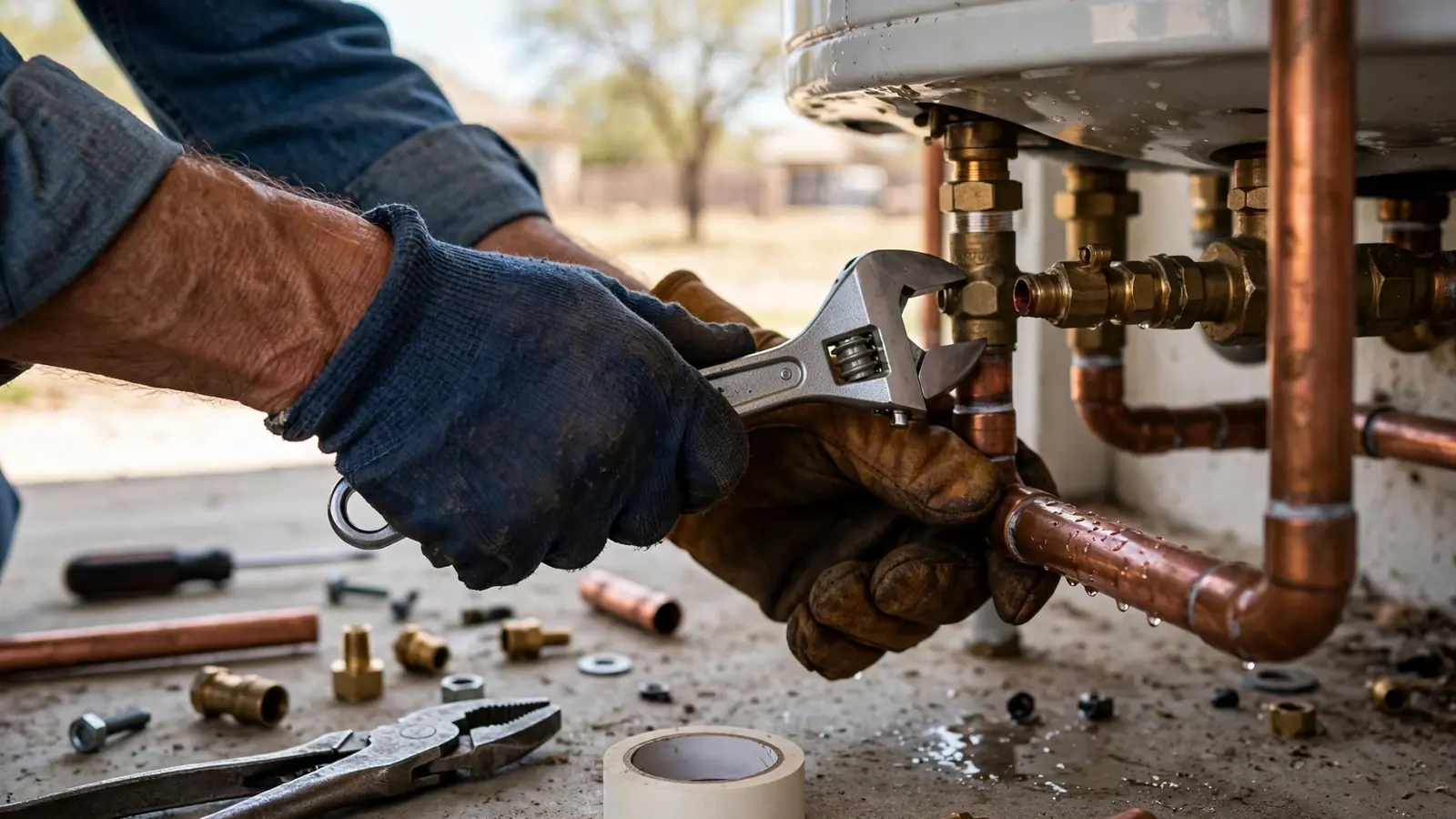
Start with the simplest causes. For an electric heater, check the breaker and the red reset button. For a gas heater, check that the gas control is on and the pilot is lit. If those check out and the water is still cold, a heating element, thermostat or thermocouple has likely failed. Call (385) 488-1892 and a plumber can come out any hour.
Nine checks, easiest first
Check other fixtures
If hot water is missing at only one tap, the heater is fine and the faucet or mixing valve is the problem.
Look at the breaker
For electric heaters, flip the breaker off and on once. If it trips again, stop and call.
Press the reset
Electric heaters have a red reset button behind the upper access panel. Switch off the breaker before opening the panel.
Check the thermostat setting
The dial should sit around 120 degrees. A setting knocked down can mean lukewarm water.
Check the gas valve
On a gas heater, the control should be on and the knob should sit on the pilot or on position.
Look at the pilot
A blue pilot flame that stays lit is normal. If it keeps going out, the thermocouple may be weak.
Feel the pipes
A cold inlet and warm outlet is normal. If both are cold, the heater is not heating.
Check for leaks
Water around the base means the tank may have failed. Shut off the cold supply and call.
Listen
Popping and rumbling point to sediment. Hissing near the relief valve means pressure or temperature is too high.
Gas versus electric: who fails how
| Heater type | Common failure | Sign |
|---|---|---|
| Electric | Upper or lower heating element | No hot water or runs out quickly |
| Electric | Thermostat | Water too hot, too cold or inconsistent |
| Electric | High-limit switch tripped | No hot water until reset |
| Gas | Thermocouple or flame sensor | Pilot will not stay lit |
| Gas | Gas control valve | No burner at all or repeated lockout |
| Both | Sediment or scale | Popping, slow recovery, rust-colored water |
The distinction matters because the safe response differs. With gas, a smell means leave and call the gas utility before you do anything else. With electric, always turn off the breaker before opening a panel.
Draper note: hard water and tank life
Draper City's 2022 water quality report lists total hardness from 16 to 357 mg/L, with the high end counting as very hard on the USGS scale. Hard water leaves scale inside a tank and on elements, which shortens their life. If your heater is under ten years old and failing early, scale is a likely contributor.
Which hardness you get depends on which utility serves you. The Utah Division of Water Resources puts Draper City generally west of I-15 and south of 14600 S and WaterPro generally east of I-15 and north of 14600 S. Ask the utility on your bill for current numbers.
Repair or replace?
If a single part failed on a heater that is otherwise sound, repair is usually the sensible move. If the tank leaks from the body or seams, replacement is the answer, because a tank cannot be patched. Rust-colored hot water, heavy sediment and an age past a decade all tilt the decision toward a new unit.
Our pages on water heater repair and water heater replacement explain what each visit includes. If you are considering a different type of heater, tankless units are an option with their own tradeoffs.
Still no hot water?
Call and tell us gas or electric. We often fix it on the first visit.
A quick word on pilot lights and venting
A gas water heater needs fresh air to burn and a clear vent to carry exhaust out. Storing paint, solvents or boxes around the unit blocks both. If your garage heater lost its flame after you stacked storage against it, move the items first. A flame that flickers yellow or lifts off the burner is a different problem and needs a technician before the unit runs again.
Safety notes you should not skip
Before you touch the heater
- Turn off the breaker before opening any electric heater panel.
- If you smell gas, leave the house and call the gas utility.
- Do not cap or block the relief valve. It protects against dangerous pressure.
- Do not relight a pilot that keeps going out. Call a plumber.
- Keep flammable liquids away from a gas heater.
What a plumber checks that you cannot
With the power safely off, a plumber tests each heating element for continuity and the thermostat for calibration. On a gas unit, we test the thermocouple output, inspect the burner for soot, confirm draft at the vent and check the gas control. Those tests tell us whether a part is worth replacing or whether the tank has aged out.
We also check pressure and temperature. A relief valve that drips can be telling you that supply pressure is high, that thermal expansion has nowhere to go or that the tank is overheating. An expansion tank is a small fix to a recurring problem, and it is worth asking about if your home has a backflow device or a pressure reducing valve.
Keep it from happening again
Flush the tank yearly
Draining a few gallons clears sediment and slows scale.
Check the anode rod
It protects the tank and wears out. Replacing it extends tank life.
Test the relief valve
Lift the lever briefly to confirm it flows and reseats.
Consider a softener
If scale is a repeating problem, a softener protects heater and fixtures.
Sources and standards behind this page
Safety steps follow manufacturer instructions, and replacement parts and installation follow the International Plumbing Code (IPC) as amended by the Utah State Construction Code in Utah Code Title 15A. Hardness figures come from Draper City's 2022 water quality report, and the USGS scale defines very hard water.
Straight Answers
On an electric heater, the usual causes are a tripped breaker, a failed element or a bad thermostat. On a gas heater, they are a pilot that went out, a worn thermocouple or a faulty gas control.
Turn off the breaker, remove the upper access panel and press the red reset button, then replace the panel and turn the breaker back on. If it trips again, call a plumber.
A failed lower element or heavy sediment is the usual cause. Flushing the tank may help. If the problem persists, a plumber can test the elements.
Many manufacturers suggest about 120 degrees, which balances comfort and scald risk. Check the label on your unit.
Yes. Draper City reports total hardness up to 357 mg/L at some sources, and scale shortens the life of tanks and elements. Yearly flushing helps.
Yes. Call (385) 488-1892 any hour. Shut off the water if the tank is leaking, and a plumber will diagnose the unit.